Some of you may have heard the word “AI wrappers” but not know what the term means. These are software layers that sit on top of existing AI models, providing a user-friendly interface but often without deep innovation. They make AI easier to use but are sometimes criticized for being “thin” solutions that don’t fundamentally transform workflows.
⚙️ How They Work
Intermediary Layer: Wrappers act as a bridge between the AI model and the end-user.
Customization: They may add domain-specific prompts, templates, or workflows.
Examples:
Jasper – a content creation tool built on top of GPT.
Now, Google has decided to support early-stage AI ventures in India. The program, called “Atoms”, was launched in November to support early-stage AI ventures in India. Each selected startup will receive up to $2 million in funding from Accel and Google’s AI Futures Fund, along with $350,000 in Cloud and AI compute credits from Google.
According to Accel partner Prayank Swaroop, nearly 70% of the 4,000 applications were rejected for being wrappers, while others fell into oversaturated categories such as marketing automation and recruitment tools. Instead, the chosen startups focus on areas with stronger potential for real-world adoption.
Google’s AI Futures Fund director Jonathan Silber has emphasized that the program does not require startups to use Google’s models exclusively. Instead, the initiative aims to gather feedback on how different AI models perform in practice, feeding insights back to Google DeepMind to improve future systems. Silber described this as a “flywheel” effect — where startup experimentation accelerates AI development.
India’s AI ecosystem remains largely enterprise-focused, with 62% of applications centered on productivity tools and 13% on software development and coding. Swaroop noted he had hoped to see more innovation in healthcare and education, areas still underrepresented in submissions.
The announcement underscores both the promise and challenges of India’s AI startup scene: while enthusiasm is high, investors are increasingly cautious of superficial solutions. By backing startups that go beyond wrappers, Google and Accel are signaling a preference for deeper, workflow-transforming AI applications.
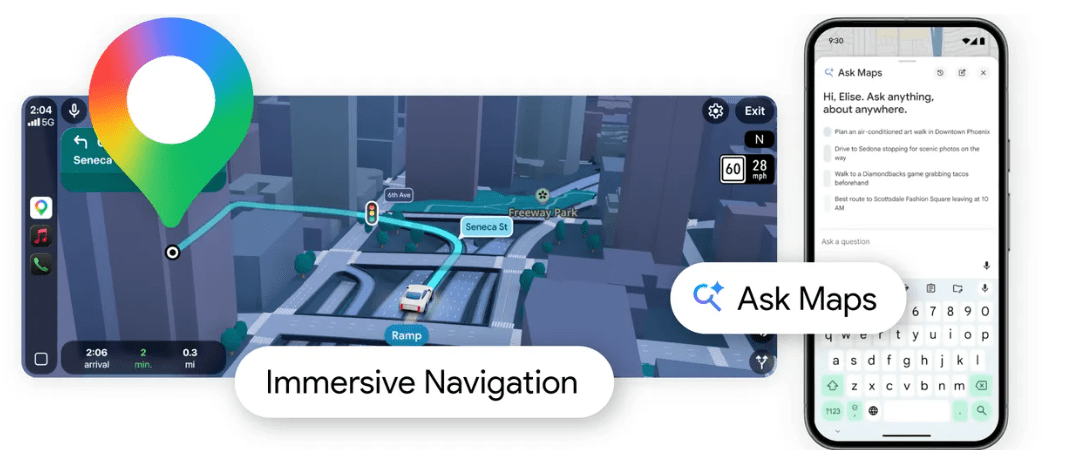
Google has announced a major upgrade to its Maps platform, unveiling two new AI-driven tools: “Ask Maps and Immersive Navigation”.
Ask Maps allows users to interact with Google Maps conversationally, posing complex questions such as where to find a tennis court with lights or a charging station with minimal wait times. Drawing on data from over 300 million places and insights from 500 million contributors, the feature provides tailored recommendations, trip planning, and seamless booking options.
Meanwhile, Immersive Navigation enhances the driving experience with vivid 3D visuals, highlighting lanes, crosswalks, and traffic lights. Powered by Google’s Gemini AI models, it integrates Street View and aerial imagery to deliver realistic guidance. Features include natural voice directions, smarter zooms, real-time traffic updates, and detailed final-stretch assistance for entrances and parking.
Together, these tools position Google Maps not just as a navigation app but as a comprehensive AI assistant for everyday mobility, blending real-world data with advanced machine learning to improve convenience and safety.
Public-sector employees are now using AI at rates that rival the private sector, with Gallup reporting that 43% of government workers engaged with AI tools in late 2025 — a dramatic rise from just 17% in mid-2023.
This surge highlights a rapid closing of the technology gap between government and business, despite longstanding challenges in recruiting technical talent and navigating stricter governance frameworks.
The study shows that while private-sector employees still lead in frequent AI use (25% vs. 21%), public-sector workers surpass them in occasional use (22% vs. 16%). This balance puts government slightly ahead in overall adoption. Analysts attribute the growth to the accessibility of generative AI tools, which require little specialized training, allowing employees to experiment independently.
Crucially, the report emphasizes that managerial support is the decisive factor in whether AI experimentation becomes routine. In public-sector organizations with strong leadership backing, 65% of employees use AI frequently, compared with only 37% in low-support environments. The findings suggest that leadership strategies — not just technology access — will determine whether AI adoption translates into lasting productivity gains.
Challenges Remain
Despite the rapid rise in AI adoption across the public sector, Gallup’s study points out several persistent challenges. Government agencies continue to face difficulties in attracting and retaining technical talent, which limits their ability to fully integrate advanced AI systems. Strict governance and compliance frameworks also slow down experimentation compared to the private sector. Moreover, without strong managerial support, many employees remain hesitant to move beyond casual use of AI tools, leaving productivity gains unevenly distributed. These hurdles suggest that while adoption is accelerating, the path to sustainable and transformative AI use in government still requires deliberate investment in leadership, training, and policy innovation.
If you spend time on the Internet today, you may have noticed something strange. Articles that say a lot but mean very little. Social media posts filled with generic advice. Images that look impressive at first glance but make no real sense. Much of this growing flood of low-quality content has a new name: “AI slop”.
AI slop refers to large amounts of content created quickly using artificial intelligence tools but with little care, accuracy or originality. The word “slop” is used deliberately—it suggests something messy, mass-produced and not very nourishing.
A new study has revealed that artificial intelligence (AI) is making it significantly easier for hackers to unmask anonymous social media accounts.
A report in the Guardian has said researchers demonstrated that large language models (LLMs), the same technology powering platforms like ChatGPT, can match anonymous users with their real identities across different platforms by analyzing the details they share online.
🔍 How It Works
LLMs scrape information from anonymous accounts and cross-reference it with other public data.
Even small personal details—like mentioning a pet’s name or a local park—can be enough for AI to link accounts with high confidence.
This lowers the barrier for hackers, who now only need access to public AI tools and an internet connection to launch privacy attacks.
⚠️ Risks Highlighted
Government surveillance: Dissidents and activists posting anonymously could be identified.
Personalized scams: Hackers can craft spear-phishing attacks by posing as trusted contacts.
Data misuse: Beyond social media, public records such as hospital admissions or statistical releases may no longer meet anonymization standards in the age of AI.
This study underscores a fundamental shift in online privacy, raising urgent questions about how institutions and individuals should protect anonymity in the AI era.
Many of you must have heard of “OpenClaw” by now, but some may still not know what this project is all about. “OpenClaw” is an open-source project that aims to recreate or emulate advanced AI “reasoning” capabilities similar to those seen in proprietary systems. It emerged as part of the broader open-model movement, where developers try to replicate powerful commercial AI features in transparent, community-driven ways.
For ordinary users of generative AI tools, OpenClaw is not a mainstream app like ChatGPT or Claude. Instead, it is more of a behind-the-scenes framework or model setup that developers can run locally or adapt for research. Still, its goals and the controversy around it matter to everyday users because they touch on privacy, transparency, cost, and AI safety.
What OpenClaw is Trying To Do
OpenClaw was designed to reproduce structured reasoning behavior in large language models (LLM). That means:
Producing clearer step-by-step thinking.
Handling logic, math, and planning tasks more reliably.
Making reasoning more inspectable and less of a “black box.”
In practical terms, it often uses prompting strategies, training tricks, or model fine-tuning to make open-source language models behave more like advanced proprietary systems.
Why ordinary users should care
Even if you never install OpenClaw yourself, projects like it influence the AI tools you use every day.
They push open models to become more capable.
They reduce dependence on a few big companies.
They help researchers study how reasoning actually works in AI systems.
They can eventually lower costs, since open models can be run without expensive subscriptions.
Pros of OpenClaw
Greater transparency Because OpenClaw is open source, its methods can be inspected. Researchers and developers can see how reasoning is structured instead of relying on a closed commercial system.
Community-driven innovation Developers around the world can experiment, improve it, or adapt it for new tasks. This often accelerates progress.
Lower cost and local control In principle, OpenClaw setups can be run on local hardware or private servers. That appeals to users and organizations concerned about data privacy or subscription fees.
Faster experimentation Open projects can iterate quickly. When someone finds a better prompting method or fine-tuning trick, it can spread rapidly across the community.
Cons of OpenClaw
Complex setup It is not plug-and-play. Running it typically requires technical knowledge, hardware resources, and time.
Inconsistent quality Because it is community-driven and built on open models, performance may vary. It may not match the reliability or polish of commercial systems.
Limited support There is no guaranteed customer service. If something breaks, you rely on documentation or community help.
Safety variability Commercial AI providers invest heavily in safety testing and alignment. OpenClaw setups may have fewer guardrails, depending on how they are configured.
Why OpenClaw Became Controversial
The controversy mainly centers on how it tried to replicate advanced reasoning features associated with proprietary AI systems.
Imitating closed-model behavior Some critics argued that OpenClaw closely mimicked behaviors associated with proprietary systems, raising questions about whether it was ethically or legally acceptable to reverse-engineer or approximate certain features.
Training data concerns There were debates about whether methods used in open reasoning replication might rely on outputs from proprietary models. If so, that raises intellectual property and licensing questions.
Safety and misuse risks Because it aimed to unlock stronger reasoning in open systems, some observers worried it could lower the barrier for misuse, including automation of harmful tasks.
Alignment debate OpenClaw became part of a broader argument in the AI world: should powerful reasoning capabilities be tightly controlled by a few companies, or openly distributed? Supporters saw it as democratization. Critics saw it as potentially reckless.
Where it Fits in Bigger AI Picture
OpenClaw sits within the larger open-source AI ecosystem, alongside projects like Hugging Face and community-driven models such as Meta’s LLaMA. It reflects a growing tension between closed, highly controlled AI systems and open, community-driven alternatives.
For ordinary users, the takeaway is simple:
OpenClaw represents an attempt to make advanced AI reasoning more open and accessible.
It offers transparency and flexibility.
It also brings technical complexity and safety debates.
Its controversy highlights deeper questions about who should control powerful AI capabilities.
Even if you never directly use OpenClaw, the ideas behind it shape the tools you do use — especially as open models continue to close the gap with commercial AI systems.
Artificial intelligence (AI) tools can now generate striking images and cinematic videos from simple text prompts. Platforms like Sora and other generative systems have made it possible for anyone to produce professional-looking visuals in minutes. But one major legal question continues to surface:
If you create an image or video using AI, is it copyrighted? And if someone else uses it without your permission, can you sue?
The answer is nuanced. Copyright law was built around human creativity, and AI challenges that foundation. Below is a comprehensive breakdown of how copyright currently applies to AI-generated works, especially in the United States, with notes on other jurisdictions.
Did you know “AI For Real” Is Also A Channel On WhatsApp?
1. The Core Principle: Copyright Requires Human Authorship
In the United States, copyright law is rooted in one fundamental requirement:
A copyrighted work must be created by a human author.
The US Copyright Office has repeatedly clarified that works produced without human authorship are not eligible for copyright protection.
This principle was reinforced in a widely discussed case involving Stephen Thaler. Thaler attempted to register an artwork created entirely by his AI system, claiming the AI as the author. The Copyright Office rejected the application because the work lacked human authorship. Courts upheld this decision.
So, purely machine-generated content — with no meaningful human creative input — is generally not protected under U.S. copyright law.
A new MIT Sloan article offers a fascinating window into how leading thinkers are reframing the conversation about artificial intelligence (AI) and its role in the workplace. Economists David Autor and research scientist Neil Thompson argue that the real story of AI is not simply about machines replacing human labor, but about how thoughtfully — or carelessly — we design systems that interact with human expertise.
The two have cautioned against the assumption that productivity gains are automatic. While generative AI can accelerate certain tasks, such as coding or drafting text, it often introduces new friction: time spent crafting prompts, verifying outputs, and waiting for models to respond. This paradox means that workers may feel faster and more capable, even when studies show their overall efficiency has not improved.
Artificial Intelligence (AI) has rapidly become a defining feature of modern military operations. Recent reports highlight that the U.S. military employed Anthropic’s Claude AI during strikes on Iran in 2026, using it for intelligence assessments, target identification, and battle simulations. Despite political controversy surrounding its use, this demonstrates how AI systems are now embedded in real-time decision-making and combat planning.
Globally, AI is reshaping warfare in several key ways. Autonomous drone swarms are increasingly deployed, capable of coordinating attacks with minimal human oversight. These systems can achieve high targeting accuracy, raising both strategic advantages and ethical concerns about lethal autonomous weapons (LAWS). AI also plays a central role in cyber warfare, where machine learning algorithms detect and counter intrusions faster than traditional defenses.
Another critical application is predictive logistics and sustainment. Defence experts emphasize that AI can forecast equipment failures, optimize supply chains, and enhance readiness, ensuring that forces remain operational under pressure. Real-time intelligence analysis powered by AI accelerates decision cycles, allowing commanders to act with unprecedented speed and precision. This capability is particularly vital in complex conflicts, such as those seen in Ukraine, where AI-driven systems are tested extensively.
However, the rise of AI in warfare raises profound ethical and regulatory challenges. Concerns include accountability for autonomous strikes, risks of escalation, and the potential proliferation of AI weapons to non-state actors. Companies like Anthropic have resisted demands for unrestricted military use, citing dangers of mass surveillance and fully autonomous weapons.
In conclusion, AI is no longer a peripheral tool but a core element of modern warfare. It enhances efficiency, speed, and accuracy, yet simultaneously introduces new risks that demand urgent international regulation and ethical oversight.
Reference:
Here’s a list of references that were used to prepare the report on AI in warfare:
NDTV. US Used Anthropic’s Claude AI In Iran Strikes Hours After Trump’s Ban: Report. (2026). Available at: NDTV World News
Brookings Institution. Artificial Intelligence and the Future of Warfare. (Updated 2025). Analysis of AI’s role in autonomous weapons, logistics, and ethics.
NATO Review. AI in Defence: Opportunities and Risks. (2025). Overview of military applications and regulatory challenges.
Center for Strategic and International Studies (CSIS). AI and the Battlefield: Lessons from Ukraine. (2024–2025). Case studies on drone swarms and predictive analytics.
MIT Technology Review. The Rise of Autonomous Weapons Systems. (2025). Discussion of lethal autonomous weapons and ethical debates.
Did you know that artificial intelligence (AI) is now playing a big role in sports? Golf is one of them. AI is transforming how golfers of all levels analyze and improve their swings. What once required hours of in-person lessons and subjective feedback can now be augmented with data-driven insights delivered in seconds.
At the core of this shift is computer vision. AI-powered apps use a smartphone or launch monitor to track body positions, club path, face angle, tempo, and ball flight. Platforms like “TrackMan” and “Foresight Sports” capture precise radar-based measurements, while newer camera-based systems analyze swing mechanics frame by frame. By comparing a player’s motion to large datasets of professional and amateur swings, the software can pinpoint inefficiencies such as early extension, over-the-top moves, or inconsistent weight transfer.