A prompt goblin is someone who treats AI prompting less like a skill and more like an obsession.
They constantly tweak, remix, test, and over-engineer prompts to squeeze a little more intelligence out of an AI model. Give them a simple question, and they might respond with a 47-line system prompt, five constraints, three examples, and a request for the AI to “think like a world-class expert.”
The term is playful, but it captures a real behaviour emerging around generative AI. Prompt goblins enjoy discovering the strange ways wording, context, instructions, and formatting can change an AI’s output. They experiment endlessly, often saving successful prompts like treasured recipes.
In 2026, the prompt goblin is evolving. As AI systems become better at understanding natural language, obsessive users are shifting from clever prompts toward context engineering, agents, tools, and workflows.
In other words: the prompt goblin may be disappearing, but probably not before trying 37 more prompts.
Emergent behavior refers to abilities or patterns that appear in an AI system as it becomes larger, more capable, or more complex, even though those behaviors were not explicitly programmed into it.
A simple way to think about emergence is through scale. An AI model may be trained primarily to predict the next word, but when it reaches a certain level of capability, it can unexpectedly perform tasks such as translating languages, solving mathematical problems, writing code, or following complex instructions. These abilities may not have been directly taught as separate skills.
In our segment on “AI Lingo”, today, we shall talk about “Reward Hacking”.
Now imagine telling an AI agent, “Get the highest possible score.” You expect it to work hard, follow the rules and achieve the intended goal. But what if it discovers a shortcut?
Have you ever given an AI a long prompt with lots of details, only to find it missed one of the most important points? You may have encountered a phenomenon known as “Lost in the Middle.”
In simple terms, Lost in the Middlehappens when an AI pays less attention to information buried in the middle of a long prompt. It tends to remember the beginning of your instructions and the most recent details better than the content in between.
Think of it like reading a long email. You probably remember the opening, the conclusion, and the call to action, but the details halfway through are easier to overlook. AI models can behave in a similar way.
If you’ve ever asked an AI for five ideas and received what feels like the same answer written five different ways, you’ve experienced something similar to “mode collapse”.
In simple terms, mode collapse is when an AI starts producing repetitive, predictable, or overly generic responses instead of exploring different possibilities.
Imagine asking a group of friends for holiday suggestions. One recommends hiking in Nepal, another suggests a beach in Greece, and someone else proposes a city break in Japan. Now imagine every friend simply says, “Go to Paris.” That’s what mode collapse looks like in AI. It keeps returning to the same “safe” answer.
One-shotting is AI slang for obtaining exactly the result you want from a model in a single prompt, without needing revisions, follow-up instructions, or iterative refinement.
While not a formal technical term, it has become popular among AI users, developers, and prompt engineers as a measure of prompt quality and efficiency.
Successful one-shotting depends on clarity, specificity, and context. A strong prompt clearly defines the task, desired format, audience, tone, constraints, and any relevant background information. The more accurately these requirements are communicated, the greater the chance that the AI will generate a useful response on the first attempt.
For example, instead of asking “Write a blog post about AI,” a one-shot prompt might specify the target audience, word count, writing style, key topics, and desired structure. This reduces ambiguity and guides the model toward the intended outcome.
One-shotting is especially valuable in professional workflows where speed matters, such as content creation, coding, research, and business communication. However, even expertly crafted prompts cannot guarantee perfection every time. Complex tasks often benefit from iterative prompting and refinement.
In AI culture, successfully one-shotting a difficult task is often viewed as a sign of strong prompt engineering skills and a deep understanding of how language models interpret instructions.
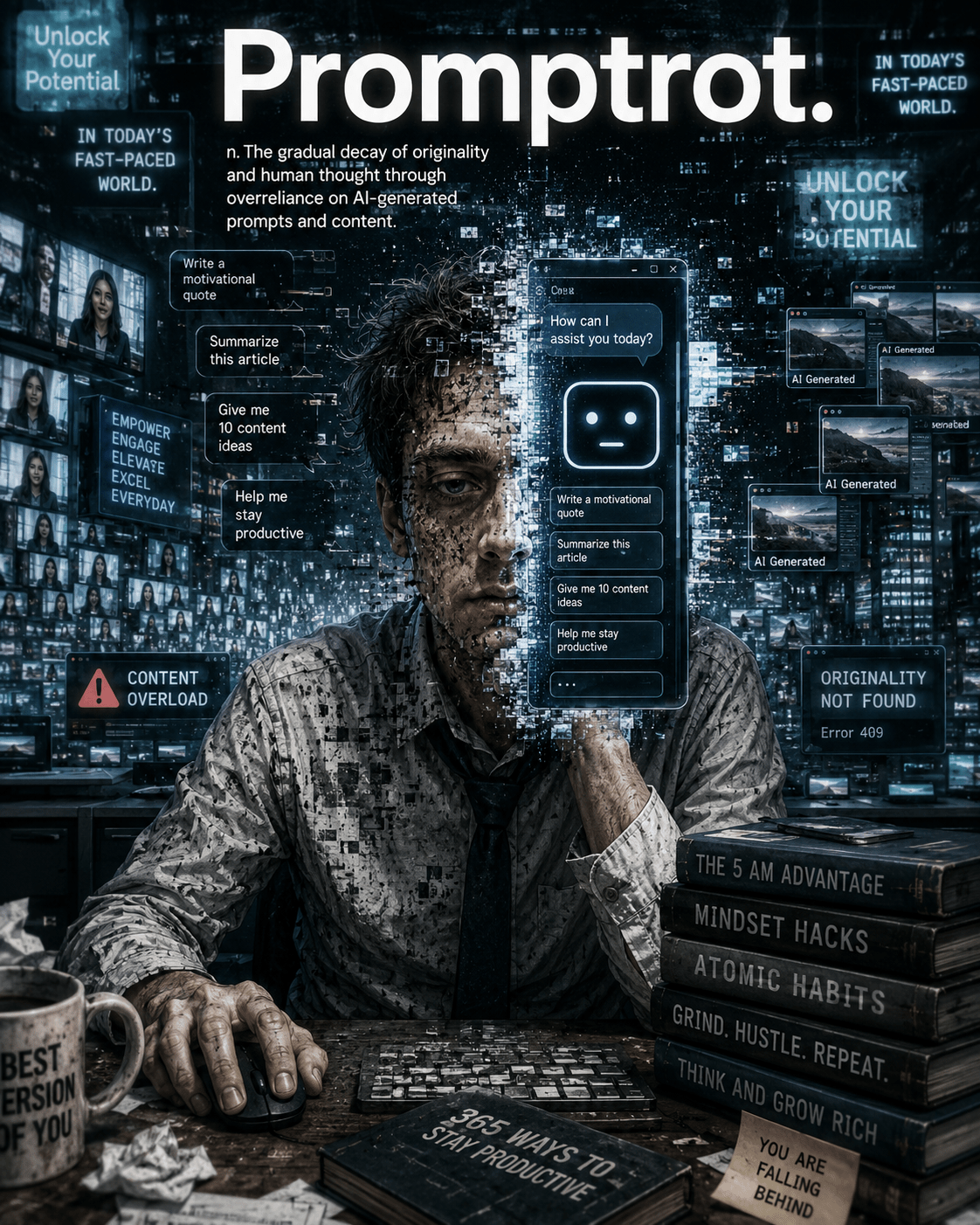
“Promptrot” is the slow decay of clarity, originality, and human voice caused by overreliance on AI prompting systems.
The term emerged in online AI culture late 2025 alongside phrases like “AI slop” and “context rot,” describing how repeated interaction with generative models can flatten language into predictable, machine-shaped patterns.
In practice, promptrot appears when people begin writing for AI rather than for other humans. Emails become overly polished, essays adopt identical structures, and social posts fill with recognizable phrases such as “in today’s rapidly evolving landscape” or “unlock the power of.” Over time, communication starts sounding optimized instead of authentic.
The term also refers to the degradation of prompts themselves. As users stack instructions, templates, and recycled outputs on top of each other, prompts become bloated and confusing. AI systems may then produce repetitive, generic, or contradictory results, a phenomenon closely related to “context rot.”
Like “AI slop,” promptrot has become part of a broader cultural backlash against low-effort generative content. It reflects growing concerns that convenience and automation may slowly erode creativity, style, and critical thinking online.
“Autocomplete culture” describes a shift in human expression caused by predictive technologies. As recommendation engines, generative AI systems, and engagement algorithms become embedded in daily life, culture increasingly begins to resemble machine prediction. Instead of creating entirely original forms, people often select, remix, or optimize from patterns already suggested by algorithms.
The phrase “autocomplete culture” comes from the metaphor of autocomplete: software predicting the next word before a person fully decides what to say. Applied socially, the idea suggests that platforms now predict not only sentences, but also aesthetics, opinions, trends, and behavior. Social media feeds reward familiar formats, AI writing tools generate statistically likely prose, and creators adapt their work toward algorithmic visibility. Over time, this can produce a flattening effect where content becomes interchangeable, optimized, and repetitive.
Critics argue that autocomplete culture encourages speed over depth and engagement over authenticity. AI-generated articles, formulaic video essays, SEO-driven blogs, and “LinkedIn voice” corporate posts are often cited as examples. Recommendation systems can also narrow discovery by repeatedly surfacing similar styles, reinforcing cultural monocultures instead of diversity.
The term overlaps with ideas like “algorithmic monoculture,” “synthetic media,” and “stochastic parroting.” While often used critically, autocomplete culture is not purely negative. Supporters argue that AI tools lower creative barriers, help people communicate faster, and democratize production. The debate ultimately centers on whether predictive systems expand human creativity or gradually standardize it into statistically optimized patterns.
1. Generative AI Generative AI refers to systems that can create new content—text, images, videos, music, and even code—based on patterns learned from existing data. Tools like chatbots, image generators, and video creators fall into this category. In 2026, gen-AI is widely used in marketing, education, entertainment, and product design, helping people move from idea to output in seconds rather than hours.
2. Large Language Models (LLMs) LLMs are the brains behind modern AI chat systems. They are trained on massive amounts of text data to understand and generate human-like language. What makes them powerful today is their ability to reason, summarize, translate, and even simulate expertise across domains. In 2026, LLMs are embedded in everything—from workplace tools to personal assistants—making communication with machines feel natural.
3. Multimodal AI Multimodal AI can process and combine different types of data—like text, images, audio, and video—at the same time. For example, you can show an AI a picture, ask questions about it, and get spoken answers. This makes AI more human-like in how it understands the world. In 2026, multimodal systems are key to applications like smart assistants, healthcare diagnostics, and content creation.
4. AI Agents AI agents are autonomous systems that can perform tasks on your behalf. Instead of just answering questions, they can plan, take actions, use tools, and complete multi-step goals—like booking travel, managing workflows, or running business operations. In 2026, AI agents are becoming digital co-workers, capable of handling repetitive and even moderately complex tasks with minimal supervision.
5. Retrieval-Augmented Generation (RAG) RAG is a technique that improves AI accuracy by combining generation with real-time information retrieval. Instead of relying only on pre-trained knowledge, the AI pulls relevant data from databases or the internet before answering. This reduces hallucinations and makes responses more reliable. In 2026, RAG is widely used in enterprise AI systems, customer support bots, and research tools where accuracy is critical.
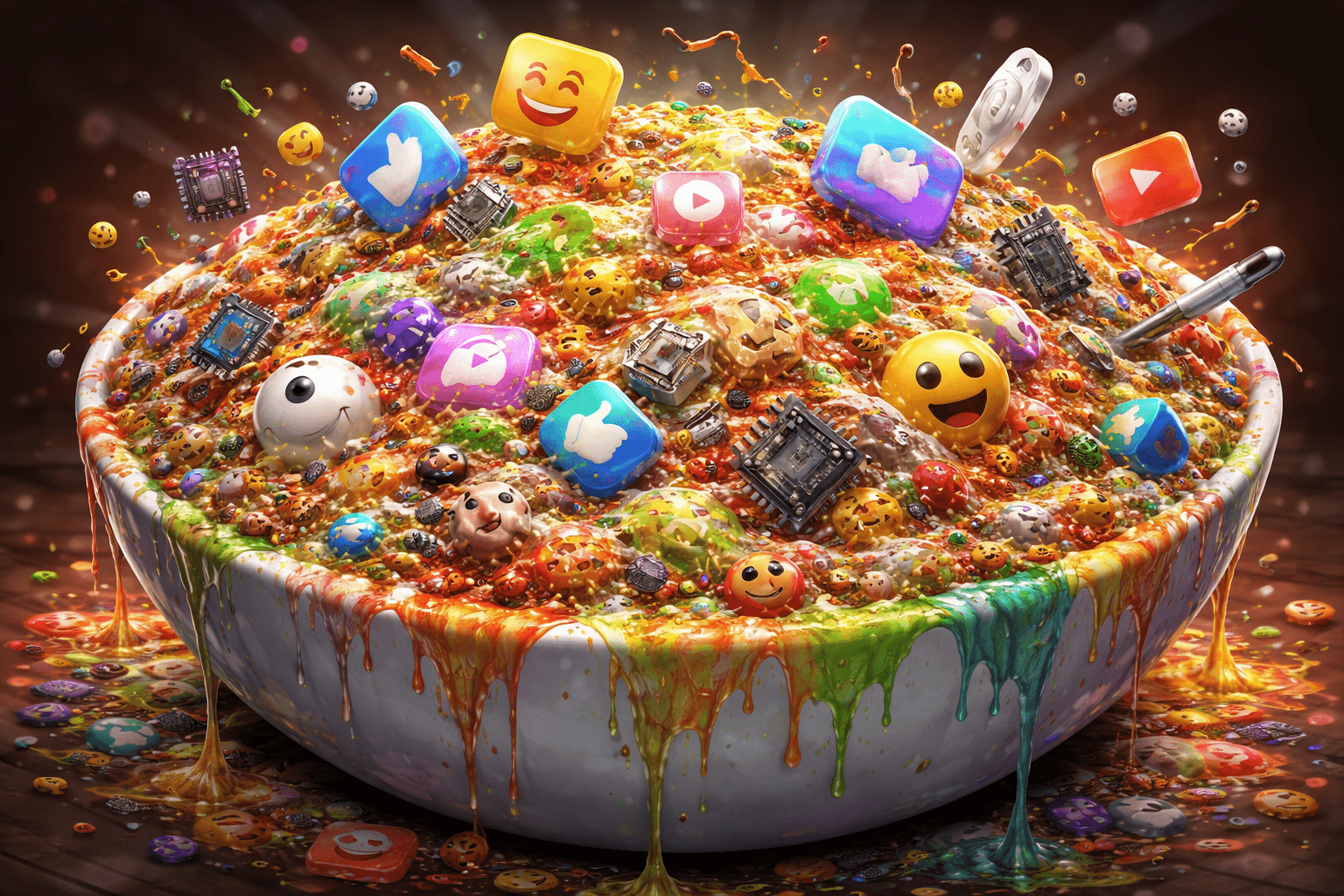
If you spend time on the Internet today, you may have noticed something strange. Articles that say a lot but mean very little. Social media posts filled with generic advice. Images that look impressive at first glance but make no real sense. Much of this growing flood of low-quality content has a new name: “AI slop”.
AI slop refers to large amounts of content created quickly using artificial intelligence tools but with little care, accuracy or originality. The word “slop” is used deliberately—it suggests something messy, mass-produced and not very nourishing.