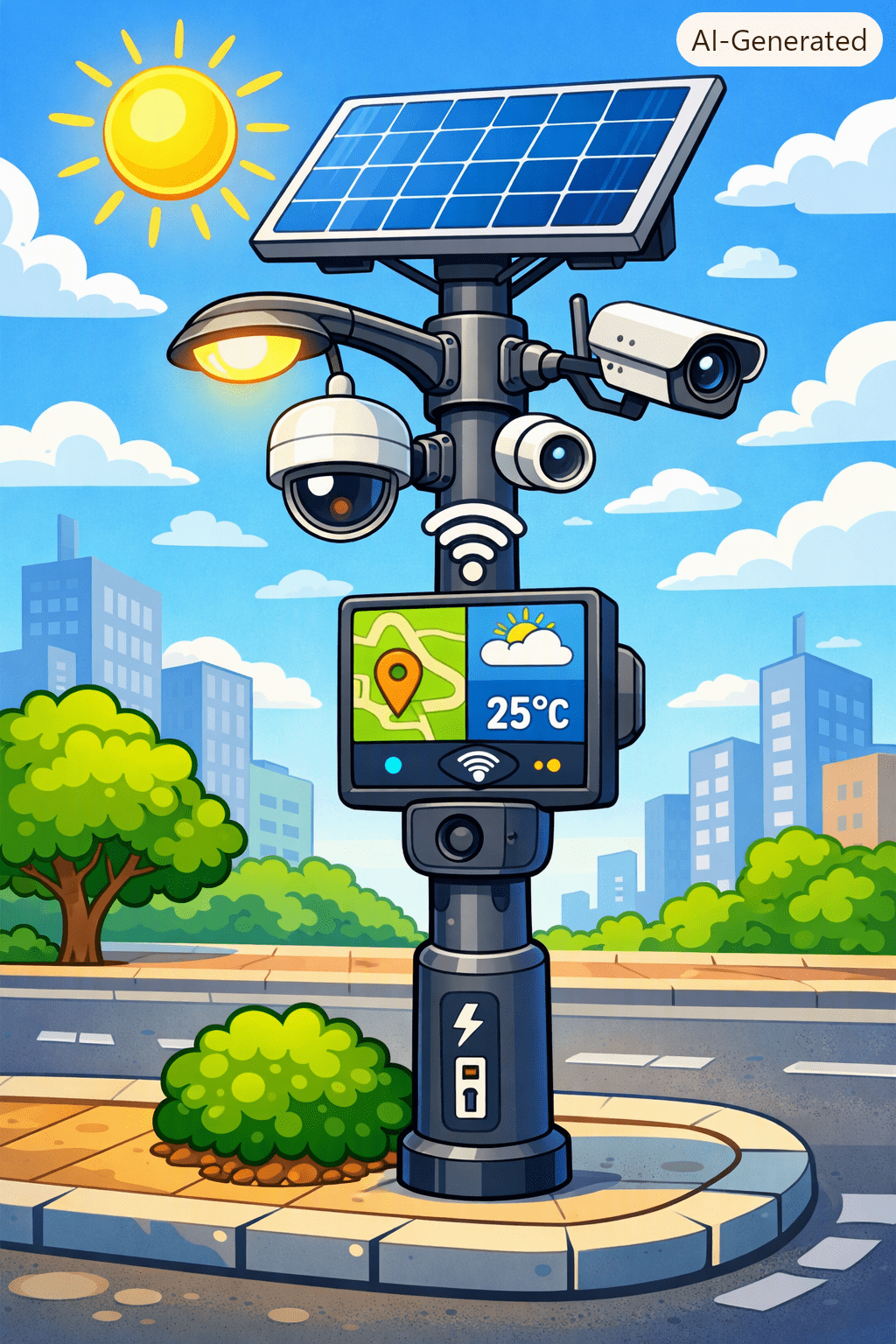
Smart lampposts are modern streetlights equipped with digital technology that allows them to do much more than simply illuminate roads and public spaces. By combining LED lighting, sensors, communications equipment, and computing capabilities, they serve as multifunctional platforms that support safer, more efficient, and more sustainable cities.
What Makes a Lamppost “Smart”?
Unlike traditional streetlights, smart lampposts are connected to a central management system through wired or wireless networks. They can automatically adjust their brightness based on the time of day, weather conditions, or the presence of pedestrians and vehicles. Many also collect data that helps city authorities understand traffic patterns, environmental conditions, and infrastructure performance.
A typical smart lamppost may include:
- Energy-efficient LED lighting
- Motion and occupancy sensors
- Air quality and weather sensors
- CCTV cameras for public safety
- Public Wi-Fi access points
- 4G or 5G small-cell equipment
- Electric vehicle charging points
- Emergency call buttons
- Digital information displays
- Edge computing hardware
Why Are They Becoming Popular?
Several factors are driving the rapid adoption of smart lampposts around the world.
Energy savings: LED lighting combined with adaptive dimming can significantly reduce electricity consumption compared with conventional streetlights.
Lower maintenance costs: Sensors continuously monitor lamp performance and can automatically report faults, reducing the need for routine inspections.
Improved public safety: Better lighting, integrated cameras, and emergency communication systems can help improve security and speed up incident response.
Support for smart cities: Because lampposts are already distributed throughout urban areas and have access to power, they provide convenient locations for installing communication equipment and environmental sensors.
Digital connectivity: As demand for faster mobile networks grows, smart lampposts provide ideal mounting points for small-cell antennas that improve wireless coverage.
Common Applications
Cities are using smart lampposts for a wide range of services beyond lighting.
Traffic management systems can monitor vehicle flow and help optimise signal timings. Environmental sensors can measure air pollution, temperature, humidity, and noise levels. Public Wi-Fi can improve internet access in parks and public squares. Parking sensors can guide drivers to available spaces, reducing congestion. Some installations also support disaster response by providing emergency alerts and backup communications.
Benefits
The advantages of smart lampposts extend across multiple stakeholders.
For local governments, they reduce operational costs while improving infrastructure management.
For residents, they offer safer streets, better connectivity, and improved public services.
For businesses, they provide a platform for digital services and support reliable communications infrastructure.
For the environment, reduced energy consumption and more efficient traffic management contribute to lower carbon emissions.
Challenges
Despite their advantages, smart lampposts also present important challenges.
Privacy concerns arise when cameras and sensors collect data in public spaces. Clear policies on data collection, storage, and access are essential.
Cybersecurity is another major consideration. Connected infrastructure must be protected against hacking and unauthorised access.
Installation costs can be substantial, especially when upgrading existing infrastructure, although long-term operational savings may offset much of the investment.
Interoperability is also important. Cities often need equipment from multiple suppliers to work together using common standards.
The Future
Smart lampposts are expected to become key components of future urban infrastructure. As artificial intelligence, edge computing, and Internet of Things (IoT) technologies mature, these installations will become even more capable of supporting autonomous vehicles, real-time environmental monitoring, advanced public safety systems, and intelligent energy management.
Rather than functioning solely as sources of illumination, streetlights are evolving into connected digital hubs that support a wide range of public services. Their growing popularity reflects a broader shift towards data-driven, sustainable, and resilient urban environments.