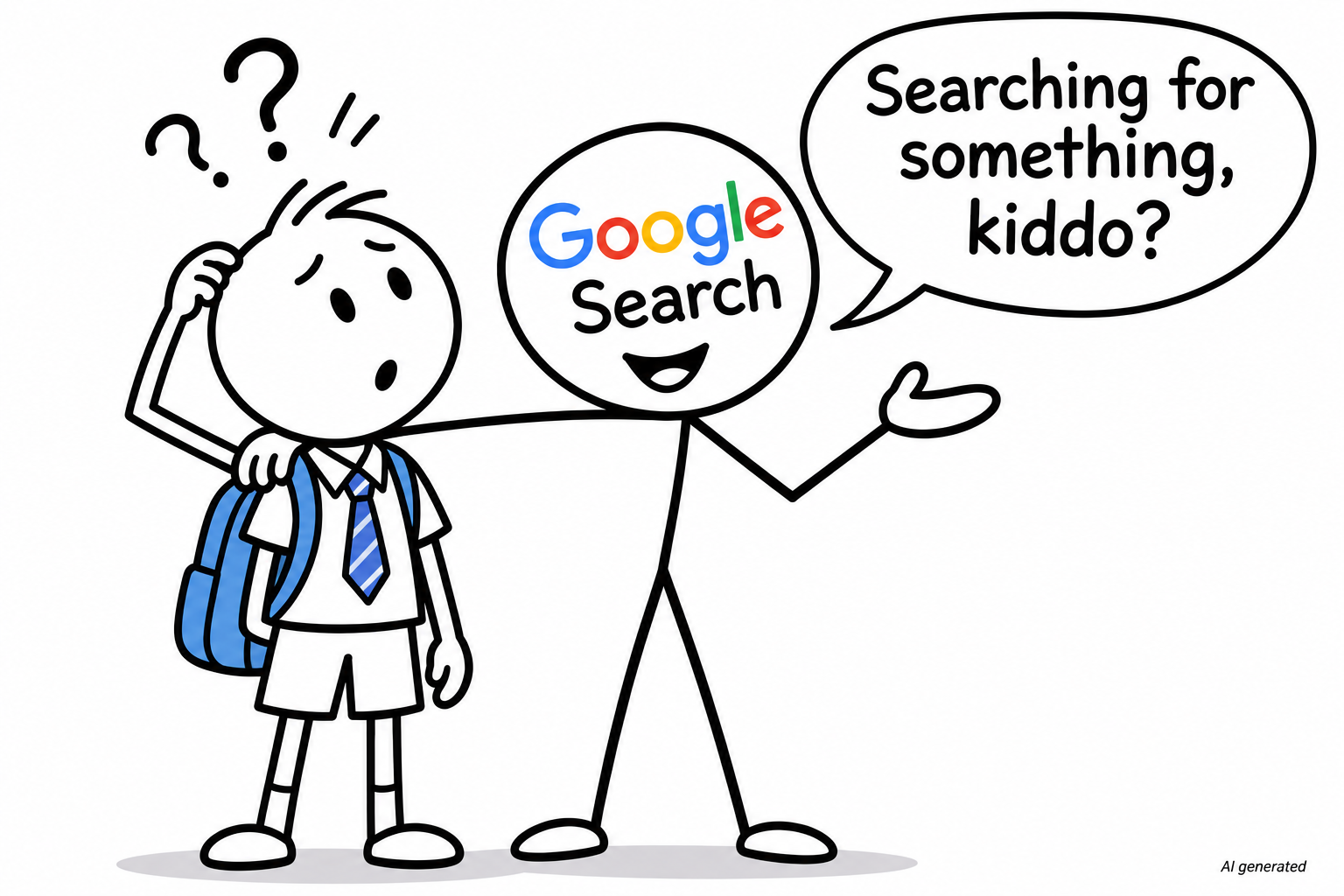
Google has announced plans to give schools greater control over the use of artificial intelligence (AI) in classrooms, switching off access to its AI products for students unless school administrators explicitly choose to enable them.
The changes, expected to begin rolling out in early 2027, will apply to K-12 student accounts and cover Google’s Gemini chatbot, Gemini Notebook, Gemini in Classroom and Google Search.
At first glance, this seems like wonderful news, right? Hold on.
In a blog post announcing the changes, Chris Phillips, Google’s vice-president and general manager of education, said access to these products would be entirely switched off until school administrators explicitly turned them on, giving schools control over how students use AI-powered tools.
On the surface, the decision appears to address growing concerns among teachers, parents and policymakers about the role of AI in education, particularly its potential to encourage students to rely on generated answers rather than develop independent research and critical-thinking skills.
However, an interview with Phillips by Forbes contributor Dan Fitzpatrick has revealed a significant qualification to Google’s announcement, raising questions about how much choice schools will actually have.
Fitzpatrick asked whether schools could remove AI Overviews, Google’s AI-generated summaries displayed at the top of search results, while retaining access to conventional Google Search.
Phillips said this would not be possible, explaining that “Search and AI are deeply integrated”.
Under the proposed arrangement, schools that decide against allowing AI in student accounts will also have to disable Google Search, removing the option of letting pupils research topics, find original sources and compare information without AI-generated summaries.
Which basically means – no AI, no Google Search. Sorry.
The distinction has fueled criticism that Google’s promise of greater administrative control over AI comes with a significant condition: schools cannot retain traditional Search while rejecting its AI features.
The decision has prompted a public backlash, with former Federal Trade Commission chair Lina Khan accusing Google of using its dominance in search to pressure schools into adopting AI.
US senator Bernie Sanders described the move as “extortion”, while New York mayor Zohran Mamdani said no corporation should have the power to dictate how children are taught.
Educators have also questioned why schools cannot be offered a conventional search option, arguing that finding and evaluating sources is an important part of learning.
Google has defended the changes as an effort to give schools more control over classroom technology, while also developing Guided Learning features intended to help students work through problems rather than simply receive answers.
The controversy, however, centers on a fundamental question: should schools have to accept AI-generated search results as the price of retaining access to one of the Internet’s most widely used research tools?
Reference:
Google’s AI opt-in policy for schools comes with a catch: no AI, no Search
Google has announced plans to give schools greater control over the use of artificial intelligence in classrooms, switching off access to its AI products for students unless school administrators explicitly choose to enable them.
The changes, expected to begin rolling out in early 2027, will apply to K-12 student accounts and cover Google’s Gemini chatbot, Gemini Notebook, Gemini in Classroom and Google Search.
In a blog post announcing the changes, Chris Phillips, Google’s vice-president and general manager of education, said access to these products would be entirely switched off until school administrators explicitly turned them on, giving schools control over how students use AI-powered tools.
On the surface, the decision appears to address growing concerns among teachers, parents and policymakers about the role of AI in education, particularly its potential to encourage students to rely on generated answers rather than develop independent research and critical-thinking skills.
However, an interview with Phillips by Forbes contributor Dan Fitzpatrick has revealed a significant qualification to Google’s announcement, raising questions about how much choice schools will actually have.
Fitzpatrick asked whether schools could remove AI Overviews, Google’s AI-generated summaries displayed at the top of search results, while retaining access to conventional Google Search.
Phillips said this would not be possible, explaining that “Search and AI are deeply integrated”.
Under the proposed arrangement, schools that decide against allowing AI in student accounts will also have to disable Google Search, removing the option of letting pupils research topics, find original sources and compare information without AI-generated summaries.
The distinction has fuelled criticism that Google’s promise of greater administrative control over AI comes with a significant condition: schools cannot retain traditional Search while rejecting its AI features.
The decision has prompted a public backlash, with former Federal Trade Commission chair Lina Khan accusing Google of using its dominance in search to pressure schools into adopting AI.
US senator Bernie Sanders described the move as “extortion”, while New York mayor Zohran Mamdani said no corporation should have the power to dictate how children are taught.
Educators have also questioned why schools cannot be offered a conventional search option, arguing that finding and evaluating sources is an important part of learning.
Google has defended the changes as an effort to give schools more control over classroom technology, while also developing Guided Learning features intended to help students work through problems rather than simply receive answers.
The controversy, however, centres on a fundamental question: should schools have to accept AI-generated search results as the price of retaining access to one of the internet’s most widely used research tools?
Sources and verification:
- Google’s original announcement: Designing responsible AI for learning, 3 November 2026.
- Forbes interview with Phillips: Schools can say no to Google AI. But they’ll lose Google Search too.
- Public reaction and political criticism: TechCrunch: Google faces backlash.
- Additional educator and policy reaction: Education Week’s analysis.