Tag: watermark

  • Duh. Someone’s Already Made A Claude Watermark Remover

    Duh. Someone’s Already Made A Claude Watermark Remover

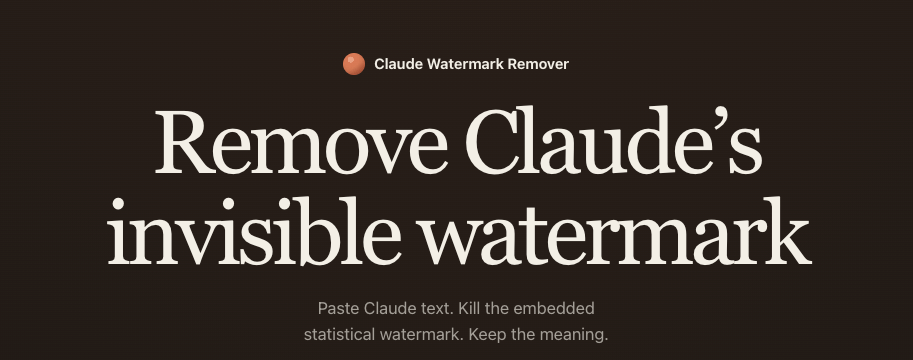
    A new online tool, “Claude Watermark Remover”, has emerged just days after Anthropic introduced an invisible watermarking system for newer Claude models, highlighting a rapidly developing contest between AI transparency measures and tools designed to circumvent them.

    The website, claudewatermarkremover.app, allows users to paste Claude-generated text and receive a re-written version designed to break the statistical signature embedded in the original output.

    According to the site, the process uses a non-Claude model to substantially alter wording and sentence structure while attempting to preserve the original meaning. The service is advertised as free and requires no registration.

  • Claude’s Watermark On AI-Generated Text And Its Implications

    Claude’s Watermark On AI-Generated Text And Its Implications

    Anthropic’s decision to watermark Claude’s output globally marks a significant new phase in the regulation of generative AI (gen-AI) — one that could change how AI-written material is identified, verified and trusted online.

    Anthropic is moving to embed machine-readable watermarks into text generated by its Claude AI models. The move follows the European Union’s AI Act, whose transparency provisions began applying on August 2.

    The rules require providers of generative AI systems to make AI-generated content identifiable through appropriate technical mechanisms. The European Commission has separately published a Code of Practice intended to help providers comply with those transparency obligations.

    According to media reports, Anthropic plans to apply the watermarking system across Claude products rather than restricting it to European users. That would include the company’s consumer chatbot and developer-facing products such as Claude Code.

    What It Means To You

    The significance is larger than a new technical feature. If AI-generated text can reliably be identified after it has been copied, pasted or lightly edited, the technology could become part of a broader infrastructure for determining where digital content came from.

    A watermark you cannot see