For those within our community who have still not got this piece of news….
“Muse” is Meta’s new personal artificial intelligence (AI) agent, designed to do more than simply answer questions. Instead of acting like a chatbot that waits for instructions, Muse is intended to take on tasks, make plans and carry out actions on a user’s behalf.
Meta introduced Muse in September 2026 as part of its push towards what it calls “personal superintelligence”.
The simplest way to understand Muse is to think of it as a digital assistant that can actually get things done.
You could ask it to organise a trip, manage a project, send an email, research a subject or help with a purchase.
Muse can use a web browser, interact with connected services and continue working on longer tasks after you have closed the app. It can then return to you when it needs approval or when something important changes.
This makes Muse different from conventional AI chatbots. With a chatbot, you might ask for a holiday itinerary and then have to book the flights and hotels yourself. With an AI agent such as Muse, the goal is for the system to handle much more of that process itself, subject to the permissions you give it.
Muse can also remember information that matters to you. For example, Meta says it could turn a recipe you saved on Instagram into a shopping list, remember dietary requirements and use that information when helping organise a dinner.
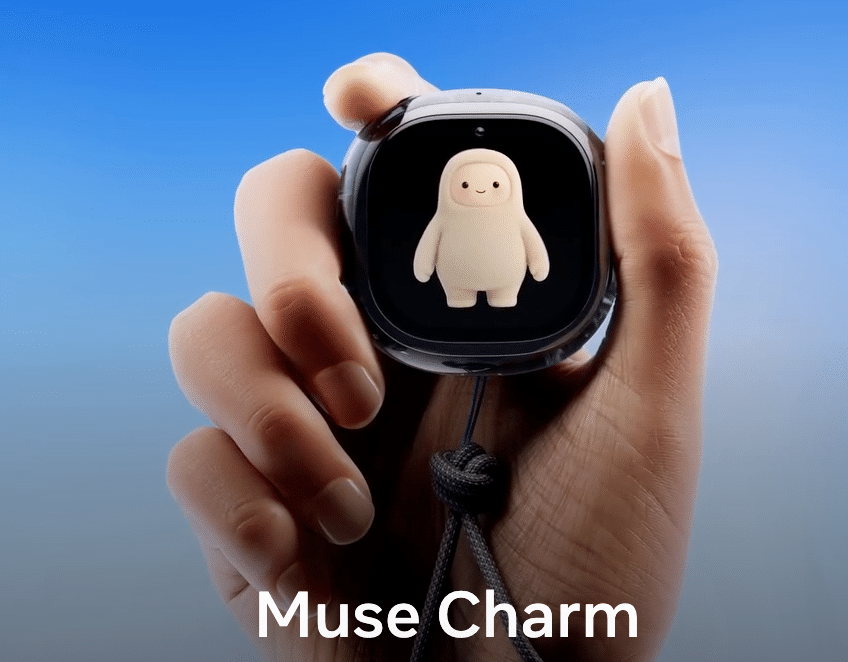
A few days ago, Meta launched “Muse Charm”.
This is a small, keychain-sized physical device designed to give people instant access to their personal Muse AI agent without having to unlock a phone or open an app.
Zuckerberg described it as a way to talk to Muse and show it what is happening around you.
The device has a small display showing Muse’s animated avatar, known internally as Jolly, and a fingerprint sensor that lets users start talking to Muse. Meta says it plans to ship the device in December, although it has not announced a price.
Here is how Meta has demonstrated it working:
- You tap the fingerprint sensor.
The sensor is built into the corner of the device. Tapping it lets you start talking to Muse without unlocking your phone or opening an app. Zuckerberg demonstrated exactly this at Meta Connect. - You speak naturally to Muse.
Charm contains Meta’s real-time voice and avatar technology, so the interaction is intended to feel like having a conversation rather than typing questions into a chatbot. The small screen displays a visual representation of your Muse while you talk. - Muse does the actual AI work.
This is the key distinction. Charm isn’t primarily there to provide computing power. It gives you a quick physical interface for reaching Muse, while Muse can perform tasks using Meta’s connected services. Meta describes Muse as an agent that can continue working on tasks in the background. - Charm can give Muse visual information.
Zuckerberg said it would be a fast way to “show it what’s going on around you”. That means, for example, you could point the device towards something and ask Muse about it, rather than having to describe what you are seeing. Meta has not yet published all the technical details of how the camera and cloud processing will work. - It can work away from Wi-Fi.
Reports from the Connect announcement say the device includes cellular connectivity, allowing it to access Muse while you’re out and about.
So why not just use your phone?
That’s actually the interesting part.
With a phone, the sequence is take out phone → unlock it → find the app → start talking.
With Charm, Meta is trying to reduce that to tap → talk.
Zuckerberg explicitly described it as the fastest way to reach Muse for people who aren’t wearing Meta’s AI glasses.
What about privacy?
Meta says privacy and security are central to how Muse works.
It runs inside a dedicated virtual computer, with controls designed to prevent it from taking sensitive actions without permission. Users decide which services Muse can access and what it is allowed to do.
Meta is also bringing Muse to its AI glasses, allowing users to interact with their personal agent hands-free and eventually ask it to act on what they are looking at.
Image credit: Meta