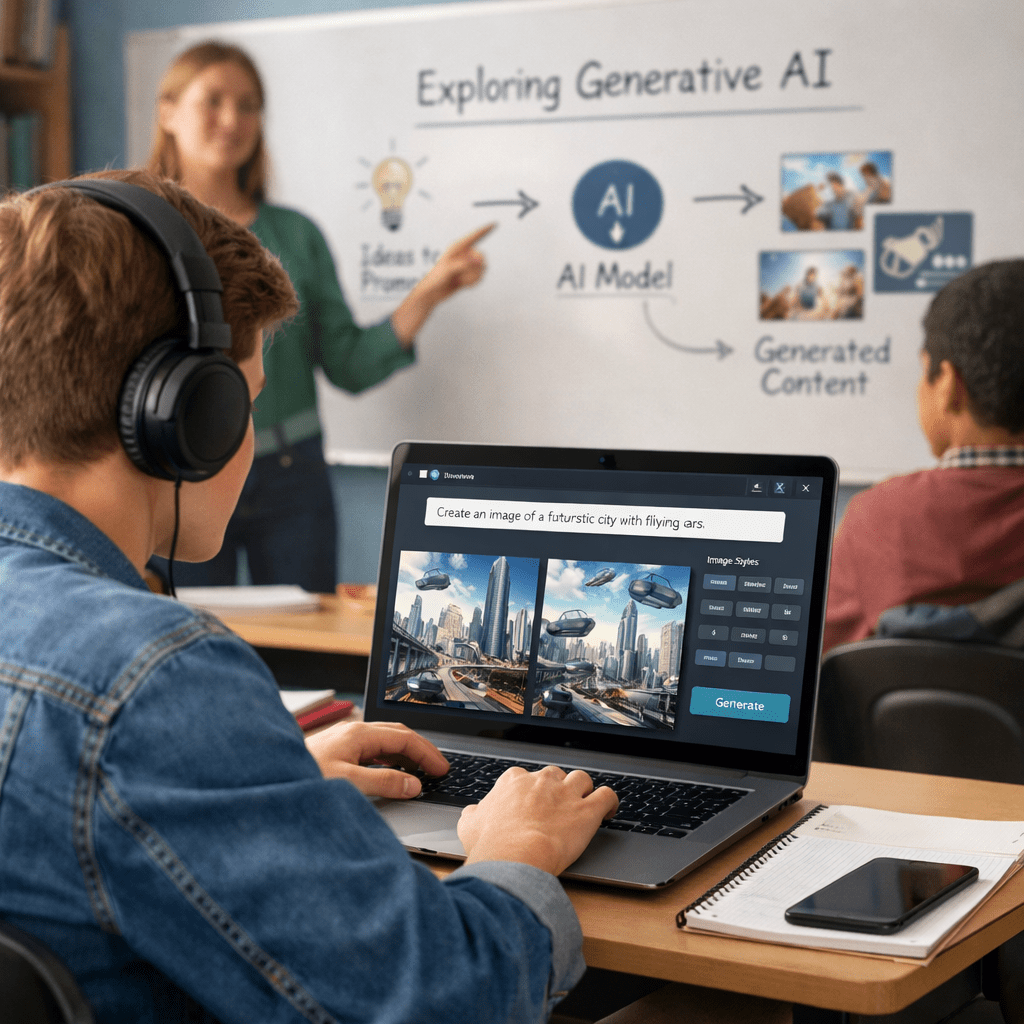
1. Generative AI Generative AI refers to systems that can create new content—text, images, videos, music, and even code—based on patterns learned from existing data. Tools like chatbots, image generators, and video creators fall into this category. In 2026, gen-AI is widely used in marketing, education, entertainment, and product design, helping people move from idea to output in seconds rather than hours.
2. Large Language Models (LLMs) LLMs are the brains behind modern AI chat systems. They are trained on massive amounts of text data to understand and generate human-like language. What makes them powerful today is their ability to reason, summarize, translate, and even simulate expertise across domains. In 2026, LLMs are embedded in everything—from workplace tools to personal assistants—making communication with machines feel natural.
3. Multimodal AI Multimodal AI can process and combine different types of data—like text, images, audio, and video—at the same time. For example, you can show an AI a picture, ask questions about it, and get spoken answers. This makes AI more human-like in how it understands the world. In 2026, multimodal systems are key to applications like smart assistants, healthcare diagnostics, and content creation.
4. AI Agents AI agents are autonomous systems that can perform tasks on your behalf. Instead of just answering questions, they can plan, take actions, use tools, and complete multi-step goals—like booking travel, managing workflows, or running business operations. In 2026, AI agents are becoming digital co-workers, capable of handling repetitive and even moderately complex tasks with minimal supervision.
5. Retrieval-Augmented Generation (RAG) RAG is a technique that improves AI accuracy by combining generation with real-time information retrieval. Instead of relying only on pre-trained knowledge, the AI pulls relevant data from databases or the internet before answering. This reduces hallucinations and makes responses more reliable. In 2026, RAG is widely used in enterprise AI systems, customer support bots, and research tools where accuracy is critical.
When you give an AI agent the ability to browse the Web, you’re handing it a passport with no visa restrictions. Left unchecked, it will go wherever it’s told — or wherever it wanders — including sites you’d never approve of, pages designed to manipulate it, or services that log every request it makes.
Without guardrails, your agent can leak data, scrape paywalled content, hit rate limits that get your IP banned, or be manipulated by a page into visiting somewhere malicious. Web access control isn’t optional — it’s a core safety layer.
Controlling which websites your agent can visit isn’t a nice-to-have. It’s the difference between a tool that works for you and one that quietly works against you.
In December 2025, I had written in one of my newsletters:
….the core question is whether delegating cognitive tasks to AI makes us more efficient or quietly atrophies the mental skills we stop exercising. Neuroimaging research shows that people who used an LLM to complete cognitive tasks showed measurably less brain activity in networks associated with deep processing and critical thinking than those who worked independently.
Researchers who used AI to compile papers were often unable to recall key information from their own work — cited as a telling sign of cognitive disengagement. Artificial intelligence (AI) is widely promoted as a force multiplier for organizations, promising efficiency, speed, and data-driven insights. Yet, a new analysis warns that careless adoption of AI risks eroding the very human skills and organizational structures that underpin long-term competitiveness.
Now, a new article in Harvard Business Review (HBR) raises almost the same concerns, but for organizations implementing AI.
The Core Concern
AI’s fluency and confidence create an illusion of competence, encouraging employees to offload critical thinking to machines, says the HBR article.
Over-reliance on AI can hollow out tacit knowledge, judgment, and interpretive reasoning—capabilities essential for innovation, crisis response, and strategic planning.
Organizations risk becoming technologically advanced but competitively fragile if they fail to protect human expertise.
Three Ways AI Erodes Capabilities
People Stop Thinking
Employees defer to AI outputs instead of developing their own analyses or strategies.
Example: Creston Telecom (Australia) found managers presenting AI-generated scenarios without being able to defend choices.
Solution: Instituted AI-free strategy sessions and a six-month “strategy residency” to preserve judgment and systems thinking.
Rules Get Buried in Systems
AI embeds subjective, moral decisions (e.g., credit approvals, promotions) into opaque algorithms.
This undermines deliberation, accountability, and adaptability.
Example: Piedmont Regional Bank (U.S.) noticed its Credit Committee leaning heavily on AI.
Response: Quarterly “credit standards roundtables” to debate evolving criteria.
Introduced apprenticeships pairing junior analysts with senior lenders, ensuring judgment and accountability remain human-driven.
Social Ties Are Weakened
AI displaces collaborative problem-solving, reducing trust and shared purpose.
Clients felt they were dealing with a “vending machine” rather than creative partners.
Solution: Banned AI-generated content in client presentations, appointed strategic leads to articulate human judgment, and rebuilt client confidence.
Key Takeaway
AI can enhance organizational performance—but it cannot:
Develop expertise through lived experience
Take moral responsibility
Build trust, courage, or shared purpose
The report says these remain irreducibly human functions. Leaders must ensure AI augments rather than replaces them, or risk losing the competitive edge that makes their organizations resilient.
It was only a matter of time. Wikipedia, the Internet’s most trusted crowdsourced encyclopedia, has finally drawn a firm line in the digital sand—and this time, it’s aimed squarely at artificial intelligence.
Frustrated by made-up facts and sketchy citations, Wikipedia has put its foot down: no more AI-written articles. Reports say the platform has barred its global community of volunteer editors from using AI tools to generate or rewrite entries. AI can still lend a hand with translations or light grammar tweaks — but when it comes to actual content, humans are very much back in charge.
Recent surveys conducted by the U.S. Federal Reserve and the St. Louis Fed show “no clear evidence” that artificial intelligence (AI)adoption has led to widespread job losses. In fact, industries with higher AI uptake are reporting faster productivity growth on both sides of the Atlantic. Job postings data also indicate that firms embracing AI are not reducing hiring compared to others, suggesting that automation is not yet driving the slowdown in recruitment.
Philippines and India
According to a recent blog post by James Pethokoukis, senior Fellow DeWitt Wallace Chair Editor, AEIdeas Blog, Apollo Global Management had tracked unemployment trends in two economies heavily exposed to outsourced service work — call centers and back-office operations. Despite predictions that generative AI would devastate these sectors, neither Manila nor India had shown signs of labor-market deterioration. Analysts noted that if automation were truly eliminating jobs at scale, these markets would be the first to feel the shock.
Programmers Worldwide There was one notable exception in programming jobs. Federal Reserve research showed employment growth among coders had slowed significantly since the launch of ChatGPT in 2022. While programmer employment continued to rise, the pace had decelerated, reflecting occupation-specific pressures rather than broader industry weakness.
Key Takeaway
Across the U.S., Europe, India, and the Philippines, AI’s labor market impact remains muted. While certain occupations —particularly programming — are experiencing slower growth, broader fears of mass displacement are not yet supported by data. Policymakers face the challenge of balancing vigilance with evidence-based action as AI adoption accelerates.
Here’s a clear breakdown of the impact of AI on jobs in each country or region mentioned in the article you’re viewing:
United States
Federal Reserve surveys show no evidence of widespread job losses due to AI.
Industries adopting AI are seeing higher productivity growth, not reduced hiring.
Programmer jobs are the exception: growth has slowed since ChatGPT’s release, though employment is still rising.
Europe
Similar to the U.S., European labor markets show no clear signs of AI-driven unemployment.
Productivity gains are reported in sectors with higher AI adoption.
Philippines
Despite heavy exposure in call centers and outsourced services, no labor-market deterioration has been observed.
Analysts note this sector would be among the first hit if AI displacement were significant.
India
Outsourced back-office and service jobs remain stable, with no evidence of mass layoffs linked to AI.
Like the Philippines, India’s service-heavy economy is closely watched as a potential early indicator of disruption.
AI coding assistants have quickly become a part of everyday life for developers. What started as simple autocomplete tools has evolved into something much more powerful; tools that feel like intelligent agents, almost like having your own “Agent Smith” sitting beside you, helping you write, debug, and understand code.
One of the most widely used tools today is “GitHub Copilot”. It acts like a reliable pair programmer who is always available. As you write code, it suggests entire lines or even full functions based on your comments. For many developers, this means spending less time on boilerplate code and more time focusing on logic and problem-solving. You can simply write a comment describing what you want, and Copilot often fills in the rest in seconds.
An AI co-scientist is not just a tool that crunches data. It’s a system that actively participates in the scientific process. Instead of only analyzing results, it can:
Propose hypotheses
Design experiments
Interpret findings
Suggest next steps
Think of it less like a calculator and more like a junior (and increasingly senior) research partner that never sleeps and can read millions of papers instantly.
2. Why Now?
Several trends have converged to make AI co-scientists possible:
a. Explosion of scientific data Modern science generates far more data than humans can process alone (genomics, climate models, particle physics, etc.).
b. Advances in AI models Large-scale AI systems can now:
Understand scientific language
Reason across domains
Work with code, math, and simulations
c. Integration with tools AI is no longer isolated. It can: