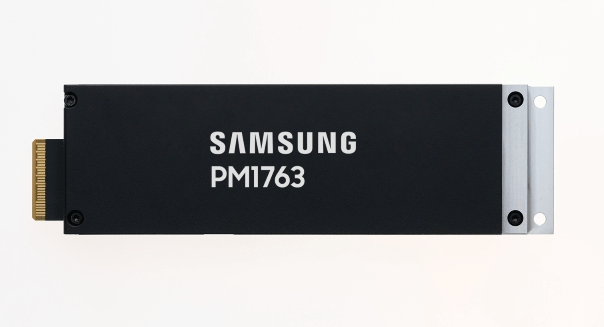
Samsung just began mass production of an enterprise SSD purpose-built for artificial intelligence (AI) and high-performance computing (HPC) servers.
Read against the backdrop of 2026’s brutal memory shortage, it’s tempting to ask: does this bring costs down? The honest answer is not directly, not soon. But it does hint at how relief eventually arrives.
(An SSD (Solid State Drive) is a data storage device that uses flash memory chips to store data, instead of spinning magnetic disks like older hard drives (HDDs).
No moving parts — data is stored electronically on NAND flash chips, so there’s nothing physically spinning or moving to read/write data.)
What Samsung Actually Shipped
The PM1763 is built on 9th-generation V-NAND and a new 4nm controller, available in 4TB, 8TB, and 16TB capacities.
The flagship 16TB drive hits sequential read/write speeds of 28,400/21,900 MB/s, over double its predecessor, the PM1753. And it’s fast enough to move a 40GB language model in about 1.4 seconds.
Where consumption of electricity is concerned, the new SSD’s power efficiency improves by more than 1.8x, and it’s designed for liquid-cooled, direct-to-chip server racks, with post-quantum cryptography baked in for security-conscious deployments.
In short: it’s a performance and efficiency play, not a supply play. It doesn’t add wafer capacity or NAND bits to a starved market.

Join AI For Real On WhatsApp For Daily Updates.
Why That Distinction Matters Right Now
2026 has been defined by what analysts are calling a “structural” — not cyclical — memory shortage.
Manufacturers have been reallocating fab capacity away from conventional NAND and DRAM toward high-margin, AI-driven products like HBM and high-capacity enterprise SSDs, since a single AI server rack can demand over 1,000TB of NAND.
It is this reallocation, not a lack of manufacturing, that is driving contract prices up. TrendForce and IDC both expect meaningful new fab capacity — the kind that would actually ease scarcity — no earlier than late 2026, with real relief likely 2027-2028.
Where A Chip Like This Actually Helps
Doing more with less is the real short-term win here, not making more chips.
If the PM1763 lets a data center handle the same amount of AI work using fewer drives, thanks to better speed and nearly double the power efficiency, that means buying fewer SSDs for the same job, and spending less on power and cooling per server rack.
For a data center operator, that can offset, not reverse, rising per-unit NAND prices. It’s a way of doing more with the same starved allocation of chips, rather than a way of making more chips available.
There’s also a signaling effect. Samsung, SK Hynix, and Micron are all funneling R&D toward exactly this segment — high-capacity, high-margin enterprise storage — because that’s where hyperscaler demand and pricing power both sit.
Bottom line for the community
Don’t expect AI infrastructure costs to fall because of this launch. Expect them to keep climbing through 2026, with a slower rate of increase for operators using the newest, most efficient hardware. Expect real price relief only once new fab capacity actually comes online, not before.
Image credit: Samsung