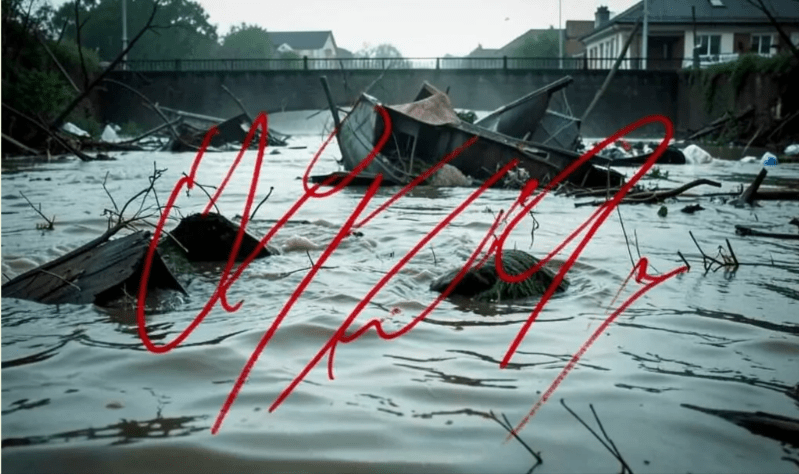
AI-generated images, recycled disaster footage and misleading captions are reportedly flooding social media alongside genuine scenes from Nepal’s catastrophe. The disturbing lesson is: natural disasters themselves are becoming raw material for synthetic misinformation.
A disaster happens. Within minutes, the Internet fills with images.
Buildings disappear beneath torrents of muddy water. Bridges buckle. Helicopters hover over devastated valleys. People run for their lives. Entire towns appear to be swallowed by floodwaters.
The instinctive reaction is to believe what we see. That instinct is now becoming distinctly dangerous.
In the aftermath of the catastrophic flash floods that struck the Nepal-Tibet border on August 26, social media users began sharing dramatic photographs and videos claiming to show the destruction. But fact-checkers have now found that some of the most striking material was not from Nepal at all.
Some of it, as it turns out, was generated by artificial intelligence (AI).
Some was real footage from completely different disasters.
And some of it was genuine footage wrapped in a false narrative.
That combination may be more consequential than any individual fake image.
The problem is no longer simply that someone can manufacture a photograph. The problem is that, during a genuine emergency, the Internet can now become a chaotic mixture of reality, recycled reality and synthetic reality — all circulating under the same headline.
And don’t blame AI for it. It’s the man behind the machine who chooses to weaponise the technology against truth.
The Flood Was Real. Some Of The Images Weren’t
A massive flash flood struck the Himalayan region near the Nepal-China border after what scientists and satellite imagery indicate was a glacier and rock collapse.
And there is genuine footage of the destruction.
That is precisely what makes the fake material so effective.
According to some media reports, AAP FactCheck examined several posts circulating after the disaster and found a striking pattern. One Facebook post showed supposedly dramatic before-and-after images of a flooded settlement. The images were not photographs of Nepal: AI analysis indicated they had been generated using an OpenAI image generator, while Meta had also labelled them as AI content. AAP reported that OpenAI’s SynthID detection found invisible AI watermarks in the images.
Another widely circulated video combined those fabricated images with dramatic footage of bridges apparently being overwhelmed by floodwater. YouTube had flagged the video’s audio and visuals as altered or AI-generated, and SynthID analysis also indicated AI generation.
Then came another category of deception.
A video shared as footage of the Nepal disaster was actually a 2021 mudslide in Atami, Japan. A reverse-image search traced the footage to reporting about that disaster. The video had simply been repurposed and presented as something happening in Nepal. AAP reported that the misleading post had accumulated more than 360,000 views.
Another clip presented as the Nepal catastrophe was actually footage from a deadly mudslide in Uttarakhand, India, in 2025.
In other words, the misinformation was not one thing.
It was a Frankenstein’s monster of AI-generated material, old disaster footage and real events stripped of their original context.
AI is Moving Into Disaster Zones
For years, fake news powered by manipulated photographs and recycled videos was largely associated with politics, celebrity scandals and conflict.
Natural disasters were different.
A flood, earthquake, wildfire or landslide already provided spectacular images. There seemed to be little reason to manufacture them.
That assumption is now obsolete.
Generative AI (gen-AI) has made the creation of convincing disaster imagery cheap, fast and accessible. A person does not need a camera crew, a helicopter or access to the disaster zone. A text prompt can produce an apparently catastrophic scene in seconds.
And the Nepal episode shows why that matters.
The goal does not necessarily have to be sophisticated geopolitical manipulation. Sometimes the motivation may simply be clicks.
A dramatic disaster photograph attracts attention. Attention generates followers. Followers can eventually be monetised through advertising, affiliate links, engagement farming or other forms of online traffic.
The tragedy becomes content.
The more shocking the image, the more valuable it can become.
The Disaster Becomes a Template?
There is something particularly bleak about this development.
A natural disaster is one of the few moments when large numbers of people turn to strangers online for information.
Families look for images of affected towns. Travellers look for information about roads and airports.
People abroad search for signs that friends and relatives are safe.
Aid organisations monitor the situation.
Journalists look for eyewitness material. Governments attempt to communicate evacuation and rescue information.
In that environment, false images do not merely pollute an abstract information ecosystem. They can interfere with the way people understand an unfolding emergency.
Recent research is beginning to examine exactly this problem. A 2026 study of AI-generated videos depicting real-world crises notes that modern video generators can fabricate realistic depictions of wars, disasters and public emergencies, creating significant misinformation risks.
Researchers also warn that the behaviour of detection systems can change when synthetic material is altered and redistributed through social networks.
Another recent study argues that misinformation during disasters should be evaluated not only by whether a claim is false, but also by how believable and harmful that false claim could be.
That is an important distinction.
A ridiculous fake photograph may be harmless. A convincing fake showing a supposedly destroyed bridge, a stranded population or a false evacuation area is something else entirely.
The Technology to Fight Back Exists
Platforms and AI companies are developing systems to identify synthetic material.
Google’s SynthID, for example, embeds invisible digital watermarks into AI-generated images, audio, text and video. Google says the markers are designed to remain detectable even after common modifications such as cropping, filtering, changes in frame rate and compression.
Meta has also said it uses industry-standard signals and disclosures to label AI-generated material on Facebook, Instagram and Threads. But the company acknowledges an important limitation: not all AI-generated content can currently be detected, and invisible markers can sometimes be removed.
But that caveat is crucial. Detection is not authentication.
And no AI detector should become the sole basis for deciding whether a piece of disaster footage is genuine.
The old tools still matter.
- Reverse-image searches.
- Checking the earliest known upload.
- Looking for the original location.
- Comparing weather and geography.
- Checking satellite imagery.
- Finding local news reports.
- Examining whether landmarks actually exist where the video claims they do.
And, above all, asking a very simple question:
Who first posted this, and when?
The new question for journalists should also be:
“Is this picture real, and does it show what somebody says it shows?”
Those are two very different questions.
Nepal Is a Real World Case Study
The most important lesson from the Nepal flood is therefore not that AI can create fake flood pictures.
We already knew that.
The real warning is that the practice is becoming normalised.
AI-generated disaster imagery can now appear alongside recycled footage and genuine eyewitness material within hours of a catastrophe.
And the incentive structure of social media encourages precisely the kind of content that performs best: dramatic, emotional, frightening and instantly understandable.
A person sitting thousands of kilometres away from a disaster can now manufacture a scene that looks as though it was captured at the centre of it.
That changes the information environment around every future emergency.
The next major earthquake, cyclone, wildfire, tsunami or flood will not merely produce a race for eyewitness footage. It will produce a race between reality and synthetic reality.
The disturbing question is no longer whether people will use AI to fake disasters. They already are.
The question is how quickly society can build a culture of verification strong enough to prevent those fakes from becoming the first version of reality that millions of people see.
Because when the ground is shaking and the water is rising, misinformation is not merely an Internet nuisance.
It can become part of the disaster.
Reference:
- AAP FactCheck: Fake flood footage inundates social media after Nepal disaster — documents multiple examples of AI-generated and repurposed footage.
- BBC News video supplied for reference
- Google DeepMind — SynthID — background on AI watermarking and verification.
- Meta — approach to labeling AI-generated content
- Reuters and AP reporting on the underlying Nepal-Tibet catastrophe provide independently verified context on the real disaster and its causes. (Reuters)
- A 2026 research paper examines the emerging threat of AI-generated videos depicting real-world crises and disasters. (arXiv)
What do you think? Write in the Comments section.